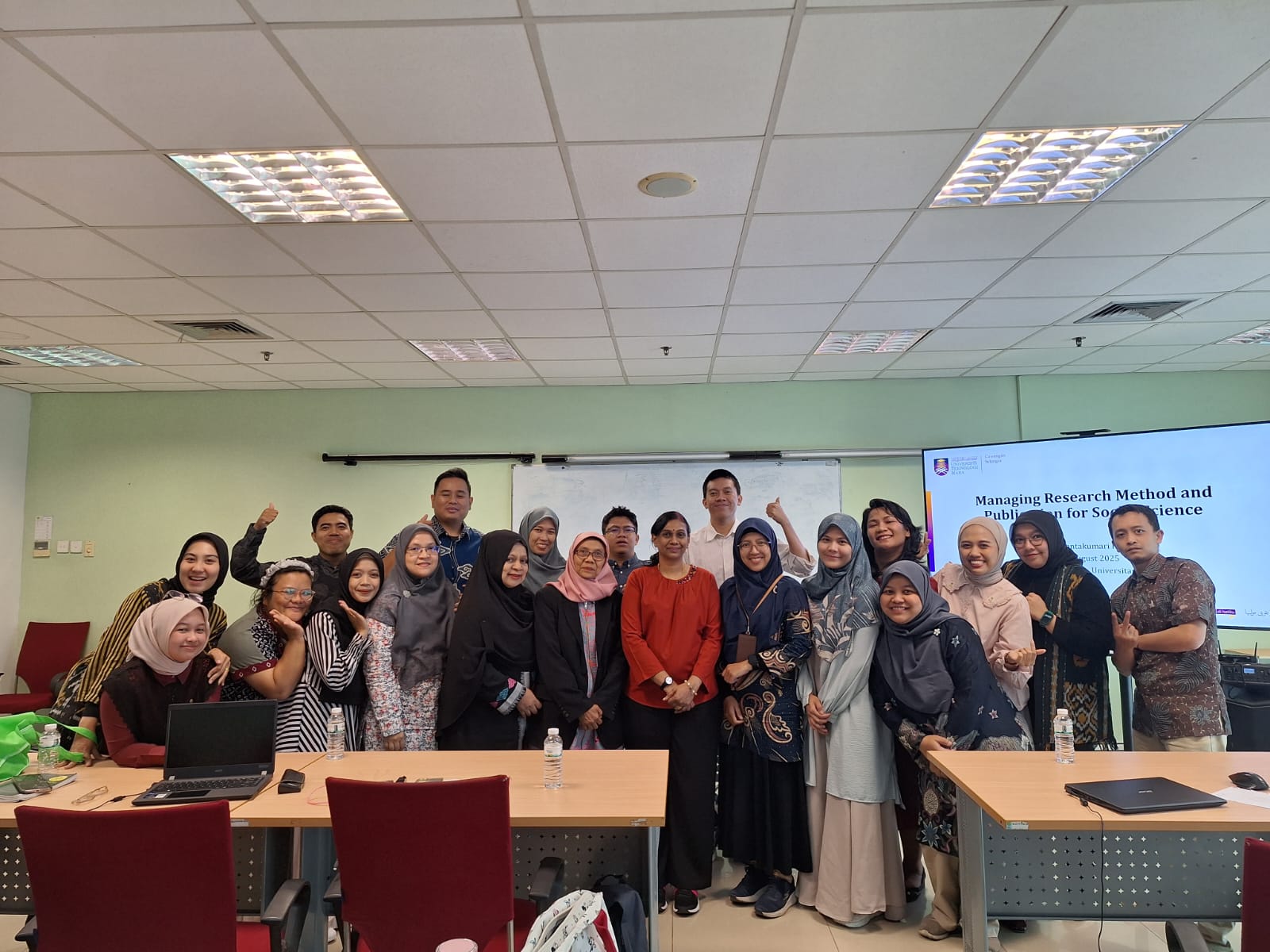
On Friday, 15 August 2025, the Faculty of Psychology, Universitas Negeri Jakarta (UNJ) hosted a visiting scholar lecture at Campus A Rawamangun featuring Dr. Shantakumari Rajan from the Center for Environmental Study, Universiti Teknologi MARA (UiTM), Malaysia. The session was moderated by one of the lecturer, Fauziah Wijayanti, M.Psi, Psikolog, and was titled “Managing Research Publication in Social Science,” brought together UNJ psychology faculty members for a practical, down-to-earth discussion on navigating journals, peer review, and the craft of clear academic writing.
Dr. Rajan opened by reframing publishing as a process of communicating contribution rather than merely reporting results. She encouraged participants to state, early and explicitly, what a study adds to the conversation and for whom it matters. From there, she walked through aligning research questions with theory, methods, and analysis so that each section of the manuscript tells a coherent story. Clarity—short paragraphs, informative subheadings, and well-designed tables and figures—was emphasized as a decisive factor for editors and reviewers.
A substantial portion of the talk addressed strategy before submission. Dr. Rajan recommended developing a shortlist of journals at the outset, reading recent articles to understand scope and audience, and checking policies on transparency, ethics, and open access. She urged caution against predatory outlets and suggested using journal checklists and author guidelines as a roadmap during drafting, not just at the point of submission.
Responding to peer review was discussed as a constructive dialogue. Participants were invited to prepare point-by-point rebuttals that thank reviewers, address each comment with specific changes (including page and line references), and provide evidence-based reasoning when proposing an alternative. The session also touched on author teamwork—clarifying roles, agreeing on authorship order early, setting internal deadlines, and documenting decisions about data handling, reporting standards, and supplementary materials.
The Q&A surfaced issues that resonate across social-science fields: matching interdisciplinary manuscripts to the right journal, balancing theoretical novelty with applied relevance, handling mixed-methods reporting, and communicating local Indonesian contexts to international audiences. Faculty members also raised practical questions about improving abstracts, and planning a pathway for resubmission when a manuscript is redirected to a different outlet. However, the most highlighted issues addressed by Dr. Rajan was it is important for a lecturer to do a consistent research work. She said that if the lecture want to have a good lecture and supervise students, they need to be updated and by doing research it would help the lecture improved their teaching quality.
The Faculty of Psychology, UNJ thanks Dr. Shantakumari Rajan for sharing insights that translate directly into everyday writing and mentoring practices. Building on this visit, the Faculty plans to continue convening academic clinics on writing, methods, and peer review to strengthen a transparent, rigorous, and collaborative research culture.